
 For years – after Hurricane Matthew, after the earthquake that rocked the South, after the roads were cut off by gangs, in the midst of fuel crises, my ever-positive colleague, Jean, who had lived through the 2010 Port-au-Prince earthquake and gone on to earn an electrical engineering degree, would unfailingly laugh when a new challenge arouse and say, “well, at least it can’t get any worse!”
About two years ago, not long after the Haitian president’s assassination, Jean stopped saying that. No one knows what’s going to happen next in Haiti, and there’s good reason to believe it might get worse. In parallel with the cascading crises, many people are working very hard to make things better. From the pinhole vantage point of Haiti that is EarthSpark, I see the dedication of colleagues, counterparts, and community members. A community member is working to donate land for a future microgrid solar array. A government engineer is out assessing sites for civil works. Teams of familiar voices report regularly to video calls from their homes in Port-au-Prince. It’s jarring to absorb the constant political and security updates, ever-contingency planning while also working to stay the course for the long-planned microgrid expansion. As we scan increasingly grim news, we also celebrate small advances. The solar-powered Les Anglais community microgrid continues to power on. The microgrid-connected solar+battery system we installed years ago in Tiburon to provide ‘redundant resiliency’ to the health clinic and the telecommunication tower is doing its job. Conditions have not been easy in the rural areas where we work, but we are relatively very fortunate. In October, right before the fire in the Tibuorn generation system, kidnappings and terror had arrived in the region where EarthSpark’s grids operate. Indeed, the first images of the plumes of smoke I saw from that fire sent me into a panic that it was a trap set to draw our colleagues to the scene to be kidnapped. (I have to laugh with tears as I type, “Fortunately it was just a normal awful fire – yay!”) A successful police raid of the incumbent gang in the Tiburon mountains has restored relative security in the area, and everyone is extremely grateful for the relative calm if leery of more violence re-erupting. We achingly wish we could do more right now, but we remain committed to working alongside communities and partners to deliver reliable electricity and build opportunity in spite of the challenges. We are hoping and planning for better days. Whatever comes next, local, reliable energy systems will remain a helpful input to the peaceful prosperity we all hope to see soon.
0 Comments
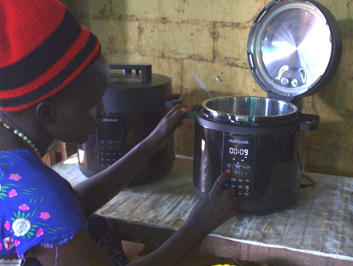
 In late October, EarthSpark had a newsletter all drafted about how, in spite of the increasing challenges in Haiti, our team was delivering excellent electricity service overall: “As Haiti’s capital city of Port-au-Prince continues to see alarming insecurity and food shortages, I am extremely proud that EarthSpark’s small team is delivering reliable electricity service to thousands of people in rural Haiti. I cannot say this for sure because there is no data available for other grids, but Ibelieve our grids are delivering what is likely the most reliable grid electricity in the entire country. The “big grid”, where it exists in Haiti, is very frequently out of service for days on end, and in some cases it has not functioned for years.” Because the EarthSpark grids are powered by solar energy, they had been insulated from the fuel shortages that had plagued the country. Our local team was managing everything locally, and – though not perfect – our service quality was very high. Then, unfortunately, a fire erupted in one of the containers at the generation site of the Tiburon grid, destroying the power electronics inside. Without these power electronics – the guts and brains of the system –no power could flow from the (undamaged) solar panels and batteries to the community.With only two grids in total, the Tiburon fire reduced by half EarthSpark’s shining counterexample of reliable electricity service in Haiti. 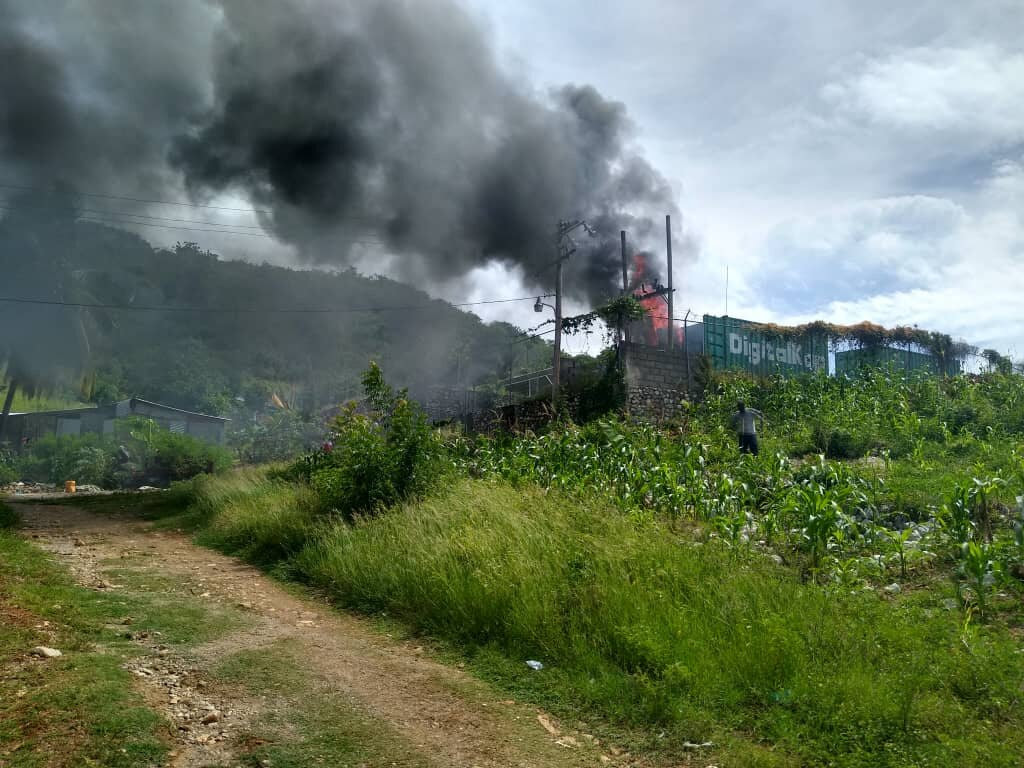 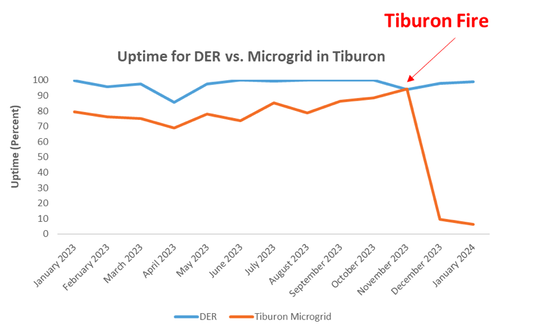 Fortunately, no one was injured in the fire, but unfortunately solar energy has not flowed to the community since. If you can, please consider supporting our campaign to repair the Tiburon grid by donating here. One point of light in the disaster is the continued functioning of the "distributed energy resource" ("DER") that EarthSpark installed on-site near the Tiburon health clinic in 2022 to offer and additional layer of resilience for the critical community services of the health center and the telecommunications tower. The microgrid-connected onsite solar + battery storage system was designed to offer a redundant layer of energy service so it could function autonomously in the event of a broader grid outage. The small silver lining of the Tiburon fire, if there is one, is that the theory of integrating DERs for critical services is proven out in practice. While the full grid service has been crippled, the DER is still providing clean, reliable electricity to the healthcare clinic and telecommunication tower. On December 24, the local EarthSpark and Enèji Pwòp teams were able to re-establish limited service in Tiburon by repurposing some spare parts and directly connecting a diesel-fueled generator. It will take months and funding to fully re-establish service. With national fuel shortages always a looming threat, Tiburon’s reliance on diesel is now very precarious in addition to being expensive and extremely difficult to manage from a logistics standpoint. Overall, 2023 delivered alarming news on the accelerating effects of climate change and the deteriorating security situation in Haiti. Against this background, EarthSpark is shouldering forward in the slow, bureaucratic processes of infrastructure development – plans, permits and financing to build dozens more resilient clean energy microgrids in Haiti – and also managing the day-to-day local operations and now repair efforts of the existing grids. This work has become even more difficult as the rising insecurity in Haiti has led many of our diligent and hard working counter-parties in the Haitian government to leave their positions, sometimes leaving the country. For those who are filling their roles, there is a steep learning curve and a very difficult working environment in which it is frequently not possible to safely move around the capital city. No matter how difficult the challenges, the EarthSpark and Enèji Pwòp teams remain committed to working towards expanded energy access for rural Haiti. Indeed the current scarcity of fuel and insecurity of travel underscore the importance of local, renewable-powered energy systems for community resilience. Alongside our efforts in Haiti, we are also now working with solar pioneers and community leaders in South Sudan and Puerto Rico to port EarthSpark’s lessons learned in community microgrids in Haiti to other under-served areas. As we stay focused on expanding service in Haiti, we’re thrilled to be supporting leaders in these other places to accelerate their own just energy transitions. As we look forward, we are taking a deep breath, appreciating all of the communities - local and international - with whom we share the work of powering forward on building clean, fair, locally-powered energy systems. Thank you for being part of this community! 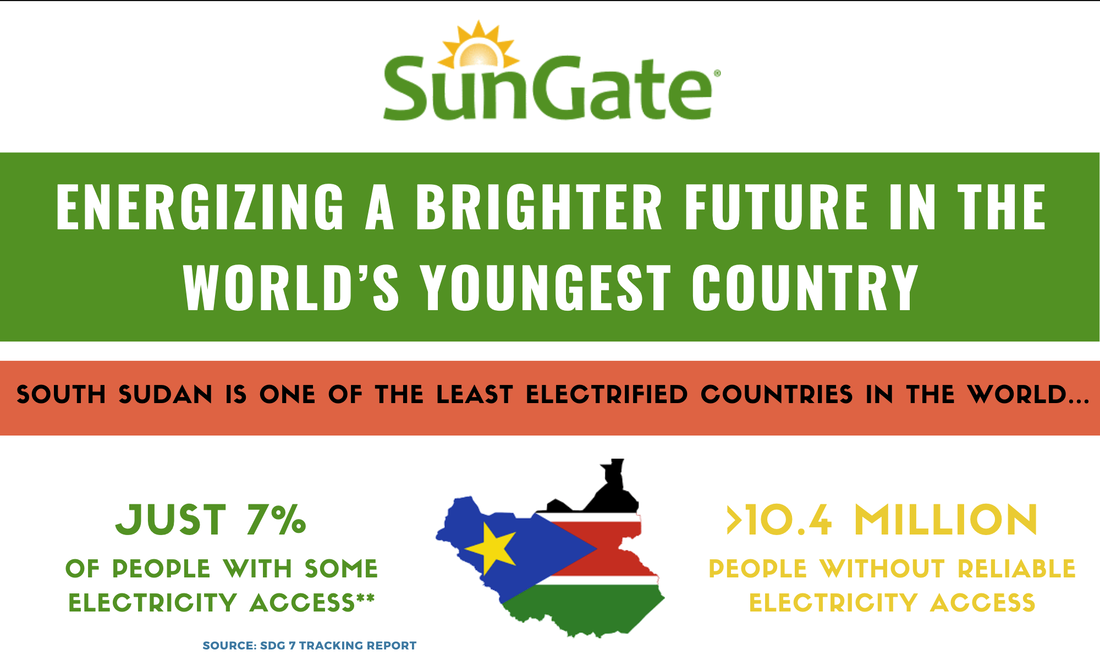 EarthSpark supported SunGate Solar, a leading solar installer in South Sudan, to launch the country's first solar-powered community microgrid. 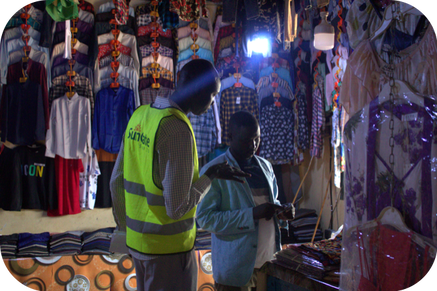 Customer engagement in Wanyjok Customer engagement in Wanyjok Some 6,800 miles away from EarthSpark’s flagship microgrid in Les Anglais, Haiti is the small rural market town of Wanyjok, South Sudan. It’s a different climate, different culture, different context, but the need and opportunity for innovation to solve energy poverty is the same. For two years, EarthSpark has been working hand-in-hand with SunGate Solar, the longest running solar installation company in South Sudan, to plan and launch the country’s first solar-powered community-level microgrid. Like Haiti, South Sudan is one of the least electrified countries in the world with only ~7% of people having access to electricity. That leaves over 10.4 million people living without electric power. The absence of electricity critically limits South Sudan’s potential economic development while also limiting the resiliency of communities, households, and businesses. 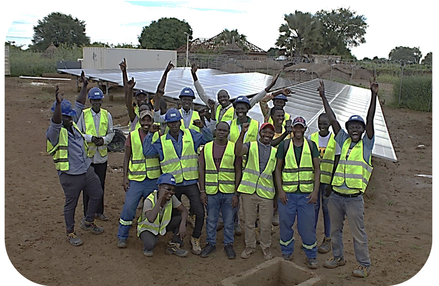 Solar microgrid launch in Wanyjok, South Sudan Solar microgrid launch in Wanyjok, South Sudan With support from Creating Hope in Conflict, a Humanitarian Grand Challenge, EarthSpark helped SunGate take a critical step towards addressing this challenge by launching South Sudan’s first solar microgrid in September 2022 in Wanyjok. Now, with over nine months of successful operation, the SunGate grid is delivering reliable, affordable, 24/7 electricity to 131 connections (over 500 people.) Ninety-eight percent of the customers are reporting no change or a decrease in energy expenses compared to previous kerosene and diesel expenses, and 61% of business customers are reporting improvements in their business operations. The majority of customers are small businesses and institutions including pharmacies, health clinics, computer/printing centers, retail stores, and restaurants. This life-changing electricity grid has reduced energy costs previously paid for unreliable diesel generators and increased opportunities for local enterprises. The lives of the entire community of Wanyjok (~20,000 people) have also been improved from the microgrid power, particularly through the streetlighting for the downtown market area. Healthcare has improved due to access to reliable electricity, local entertainment businesses are staying open later into the night and opening earlier in the day, and people are feeling more secure with a well-lit marketplace. All of this helps to bolster community resilience and socio-economic development. Before the mini-grid, diesel power was very expensive and it wasn’t reliable at all. What was worse is that the power surges would constantly damage our computers and equipment - we would sometimes lose 1-2 machines a month. Now, the mini-grid provides cheaper, more reliable power and I don’t have to worry about damage to my computers - I can just focus on teaching my students!" Building on EarthSpark’s innovative “Kwison Elektrik” electric cooking research, EarthSpark also supported the SunGate team to develop their own electric cooking pilot which deployed electricpressure cookers for 25 customers in Wanyjok as well as for SunGate’s own operations and some of its commercial solar clients.
Coupling SunGate’s existing stand-alone solar work in South Sudan (over 2 MW across over 200 sites) with the capacity and experience built from this initial pilot project, the SunGate team is now uniquely qualified and quite motivated to scale energy access solutions across the country. To that end, SunGate has secured initial agreements with two state governments in South Sudan to replicate the Wanyjok grid in new communities and also to expand the microgrid solution to a “metrogrid solution” to serve regional capitals. EarthSpark has been supporting SunGate to develop solar microgrids and electric cooking in South Sudan since 2021 when EarthSpark helped SunGate develop their initial grant proposal for the Humanitarian Grand Challenges. Leveraging lessons learned from our microgrid work in Haiti, EarthSpark has supported SunGate over the last two years to develop a solar microgrid business in South Sudan by providing a variety of advisory services supporting technical microgrid design and operations, capacity building, data reporting and analysis, communications (e.g. reports and website), research, and fundraising/investment. EarthSpark staff were also on-the-ground in South Sudan for 7 months supporting the actual building and commissioning of the solar microgrid. Reflecting on his seven months in South Sudan and the nearly two years of ongoing partnership, summarized the collaboration with SunGate, Adam Eberwein, Technical Lead at EarthSpark, summarized, “Our EarthSpark team has spent nearly a decade, day in and day out, living and working in the towns where we deliver microgrid services in rural Haiti, making improvements at every step along the way. In spite of all the differences between these two regions, it was a privilege to see how our lessons learned on one side of the world applied so well to the other. Of course, what ultimately drove the success of the project were the existing strengths of the SunGate team in specialties such as engineering, procurement, and customer support in the South Sudanese context, as well as a company culture of being willing and ready to take on every challenge that comes their way. It is because of this experience that I very much look forward to new engagements with other teams also looking to extend energy access to those most in need.” Our EarthSpark team has spent nearly a decade, day in and day out, living and working in the towns where we deliver microgrid services in rural Haiti, making improvements at every step along the way. In spite of all the differences between these two regions, it was a privilege to see how our lessons learned on one side of the world applied so well to the other." Overall, the successful microgrid project in Wanyjok has showcased the value of EarthSpark’s highly replicable and intentional approach to microgrid development for integrated energy access EarthSpark is excited to build on this foundational work to and develop additional strategic partnerships to create new pathways for scaling integrated energy access in communities around the world!
Read more about EarthSpark's newly launched Advisory Services offerings here - already the EarthSpark team is discussing inaugural microgrids in other new and exciting geographies. We can't wait to share more stories as that work progresses! 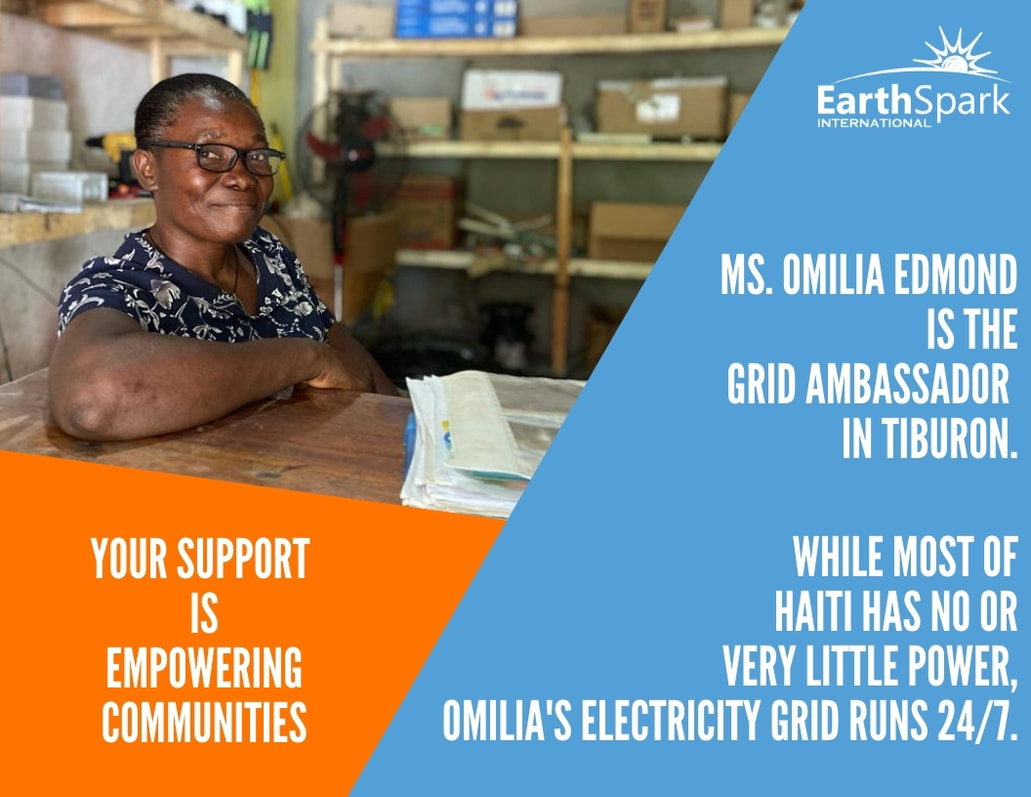 EarthSpark is delivering some of the most reliable grid power in all of Haiti now and throughout the national fuel crisis. It's been a very challenging time and far from ideal, but we can say that the lack of diesel pushed us to our 100% solar power plan ahead of schedule!
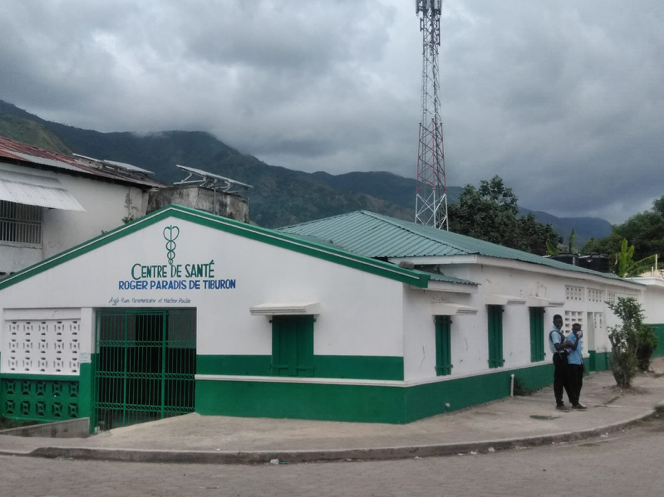
You may have heard news about the overlapping crises in Haiti: the acute political crisis, hunger crisis, cholera crisis, gang crisis. Exacerbating everything was a national fuel crisis that stopped the flow of nearly all liquid fuels in the country for many weeks. Fuel is still not flowing in the South where EarthSpark operates. It's hard to convey how challenging, frustrating and sad the working environment has been these last few months. The bright side is that the EarthSpark and Enèji Pwòp teams are amazing and are doing a phenomenal job of keeping things running in spite of the challenges. We have the privilege of seeing others in Haiti also adapting, coping, and carrying on. With roads blocked and communications systems on-and-off, the accomplishment of even a basic task can feel like a minor miracle. But miracles abound. Good work is still getting done. A local repairman fixed the air conditioner in the solar system battery container! Spare parts have gotten delivered through a phenomenal relay from Germany through Port-au-Prince to remote Tiburon. As we head into the holidays, we are grateful for our team, our community partners, and our friends around the world who support our work and, though words and actions, help make the world a better place every day. Please consider including EarthSpark in your year end giving. We have big plans and mighty mountains to climb. 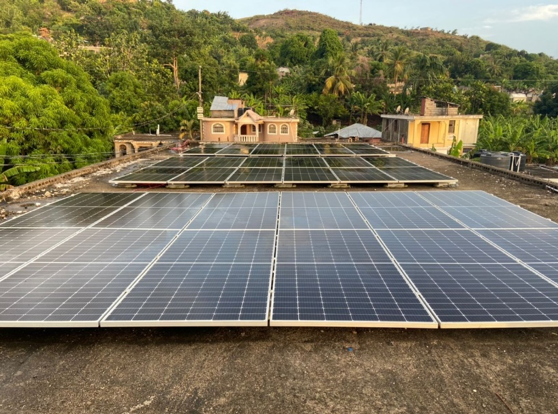 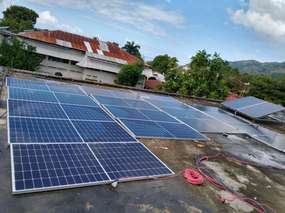 Solar panels (pre-racking) on the roof of Dispensaire Roger Paradis in Tiburon Solar panels (pre-racking) on the roof of Dispensaire Roger Paradis in Tiburon It was a blue-sky break from the rain on February 21st, when EarthSpark and Enèji Pwòp staff turned on the new microgrid-connected solar + storage solution at the health clinic “Dispensaire Roger Paradis” in the town of Tiburon. The 16.2 kWp / 77 kWh solar + storage system builds off of EarthSpark’s initial support for the clinic following the August 2021 earthquake, and was designed to provide reliable power to the downtown clinic and neighboring telecommunications tower. Different from a typical microgrid connection, this novel “distributed energy resource” (DER) on-site at a facility providing critical community services is designed to continue functioning *even if the larger microgrid were to be damaged*. Existing in the context of hurricanes and earthquakes, the EarthSpark grids have done very well overall in the face of natural disasters, but hardening the infrastructure even further for critical facilities is a strategic way to further improve the resiliency of those critical services and eliminate their reliance on their incredibly burdensome, unreliable, and expensive diesel generators. The commissioning of the new solar installation marked the culmination of EarthSpark’s long-running collaboration with the GSMA Mobile for Humanitarian Innovation Fund through which EarthSpark has been working to improve the capacity of communities hosting solar microgrids to absorb and adapt to disasters. Back in 2019 when the project launched, we had not yet faced COVID-19, the presidential assassination, the rise of kidnappings and impassibility of the roads connecting the South to the capital, the fuel crises, or the earthquake that rocked the region. Time delivered plenty of opportunities for EarthSpark to stress and validate our hypothesis, and to adapt accordingly. 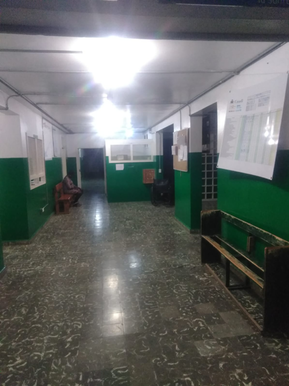 Microgrid power online in the Les Anglais Hospital Microgrid power online in the Les Anglais Hospital Distributed Energy Solutions to Build Resilience for Critical Community Services
Flipping the switch at the solar+storage solution in Tiburon marked EarthSpark's first directly service to a healthcare customer. It was also EarthSpark's first installation of a DER in one of our microgrids. This is now our foundation for designing and expanding service to other critical healthcare facilities in other grids. After EarthSpark had begun work in Tiburon, the hospital in Les Anglais also requested service. So far, that hospital has been connected to microgrid service, with the goal of eventually installing distributed solar+storage solution there as well. The Tiburon health facility DER also significant in validating a more distributed grid topography for future grids – this has the potential to reduce costs and increase resilience for future grids. This approach will need to be replicated and scaled extensively across other planned microgrids to help support EarthSpark’s vision of 100% renewable microgrids. At the outset of the GSMA Foundation collaboration, EarthSpark was also able to connect a total of three telecommunications towers from the national providers, Digicel and Natcom, across the Les Anglais and Tiburon microgrids. This not only improved the reliability of electricity service for the towers – and therefore the reliability of the telecommunications services – but also improved the financial viability of the microgrid model by creating key anchor customers for the microgrids. In fact, since the start of 2021, the two telecommunications towers in Les Anglais have accounted for approximately 18% of total electricity consumption and about 28% of total electricity revenue for the microgrid. This highlights the strategic importance of telecommunications towers not just as a critical community service, but also as a cornerstone for planning and expanding microgrids in Haiti. Mobile-Enabled Solutions and New Energy Access for Households and Small Businesses Through the GSMA project, EarthSpark also launched several mobile services to improve service, customer experience, and overall microgrid operations including:
As the EarthSpark team works to finalize concession documents and financing for the next 6 grids, these learnings and tools will be invaluable in not only improving operations in Les Anglais and Tiburon but also in designing better, more cost-effective and more resilient energy systems for the future towns than would have otherwise been possible. A big thanks to the GSMA Foundation Mobile for Humanity for supporting this work! The looming global food crisis has already arrived in Southern Haiti. Here, the global forces driving up food prices are compounded by the skyrocketing logistics challenges of transporting goods through the gang-held roads connecting the sourthern penninsula to the capital. People can't eat electricity. Kilowatt-hours make for empty meals. But EarthSpark is active on two fronts to help the communities where we work weather this growing food insecurity. First -- see below -- EarthSpark is joining agricultural and health experts in calling upon the international aid community to focus on local solutions. Local food security, like local energy security, should be the long term goal. Support for local farmers should be paramount in food aid efforts. Second, EarthSpark is launching a campaign to increase our direct support of people working in agriculture and food preservation in the towns we serve. While electricity by itself cannot feed people, electric-powered machines and mechanized processes, "productive uses of electricity", can preserve foods and expand livlihoods for people to increase their ability to feed their families through this crisis and beyond. We recognize that energy is a small part of the solution, and we all must do all we can. Please share the following letter and the sentiment widely with decisionmakers in the US and international institutions forming policies on food aid: Open Letter About food aid to Haiti Dear Development Aid Agencies and International Institutions Active in Haiti,
Our respective organizations provide a wide range of services in agriculture, healthcare and community development throughout Haiti. While there are many challenges facing our country, we come together to appeal to you in particular regarding food aid arriving in Haiti. The world appears to be on the precipice of a global food crisis of historic proportions. While years in the making, it has been triggered by the war in Ukraine disrupting crucial grain exports. Whereas nations the world over will face this new crisis while still reeling from the pandemic, economic disruption and supply chain slowdowns, Haiti will have the added burden of responding in the midst of political instability and the aftermath of the August 2021 earthquake in the southern region. The United Nations has warned that close to half of Haiti’s entire population will be confronting severe hunger no later than June, with 1.3 million Haitians one step further to the emergency stage of hunger which is just short of outright famine. This is the result of the domestic situation in Haiti even before the added pressures of a global food crisis, which will then further exacerbate the situation as international food prices continue to spiral. This will have a disproportionate effect on a country like ours that imports approximately 40 percent of its food. When the food emergency is manifest and new commitments of international aid are directed to our nation in response, the Haitian community has two requests that are accompanied with thanks, in advance, for your generous support:
While the first priority will be to reach the most vulnerable with food during the emergency, we have two additional requests:
All of us stand ready to help in the spirit of “konbit”, a Haitian tradition whereby neighbors help neighbors. May we rise together as a community united. José Andrés, World Central Kitchen Allison Archambault, EarthSpark International Skyler Badenoch, Hope for Haïti Conor Bohan, HELP Steve Brescia, Groundswell International Beaver Brooks, Much Ministries Inc. Kathy Brooks, 2nd Story Goods Ben Burke, Manzanita Outreach Sue Carlson, Raising Haiti Foundation Reginald Cean, Association Zanmi Agrikol Nathan Chariot, Mission Bon Berger d'Haiti Sheila Davis, Partners in Health Jean Raymond Delinois, ACAPE Jean Marc deMatteis, Hôpital Albert Schweitzer Patrick Dessources, CASELI Lucia Di Poi, Centre Haitien du Leadership et de l’Excellence Ulrick Gaillard, Batey Relief Alliance Timote Georges, Smallholder Farmers Alliance Frank Giustra, Acceso Cassandre Honore-Paul, Partners Worldwide Cantave Jean Baptiste, FOHMAPS/PDL Sasha Kramer, Sustainable Organic Integrated Livelihoods - SOIL Suzanne Langlois, Meds & Food for Kids Ann Lee, Community Organized Relief Effort Michael Leland, New Generation Ministries Renee Lewis, Project Medishare Louise Lindenmeyr, Hispañola Health Partners Troy Livesay, Heartline Ministries Hugh Locke, Impact Farming Foundation Guerda Nicolas, Ayiti Community Trust Ann Piper, North Coast Development Corp. Danielle Saint Lot, Danielle Saint Lot Haiti Women's Foundation Ony Saint-Hilaire, ASSOADEK Leslie Sosnowski, BoulderShares Jean Thomas, Haiti Christian Development Fund Daniel Tillias, Jaden Taptap Loune Viaud, University of Global Health Equity Haiti Carole Wakefield, Haiti Medical Mission of Wisconsin Rainn Wilson, Lidè Haiti Jane Wynne, Foundation Wynne pour l'Environnement ## The above letter was sent on April 7, 2022 under the leadership of the Smallholder Farmers Alliance. This blog post first appeared in the EarthSpark year end newsletter. If you would like to receive updates directly, please join our mailing list. 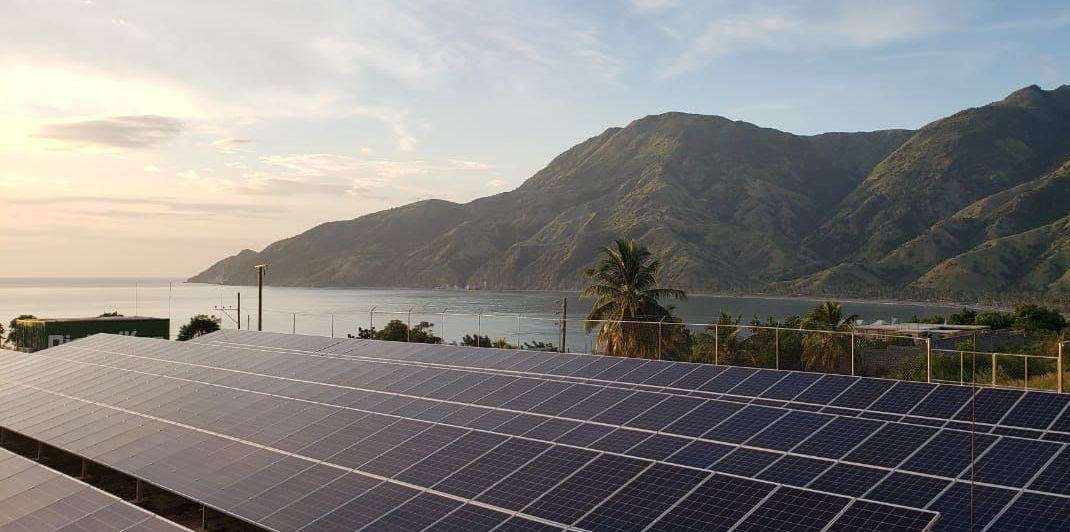 EarthSpark's solar-powered microgrids continue to provide some of Haiti's most reliable electricity service to the towns of Les Anglais and Tiburon. Whoosh – what a year! There’s been a lot to absorb and adapt to. But – deep breath – the sun still shines. Good things are happening alongside the bad. In the face of overlapping crises, we turn to what we can do. Thankfully, the EarthSpark and Enèji Pwòp teams seem eternally up for the task! New Thinking on Powering Healthcare “Who would have thought that gang violence in Haiti would provide such a powerful unintended advertisement for solar energy?” An ever-silver-lining colleague asked ironically last month as major hospitals shut their doors to new patients due to a lack of diesel. The national fuel shortage brought the country to a stand-still in many ways, and critical services closed or were severely curtailed. That was months after the August 14 earthquake had also highlighted the value of local, fuel-free energy systems. Through each of these crises, when other energy systems stopped working, EarthSpark’s solar-powered microgrids continued providing power. EarthSpark has not previously provided energy services to health facilities, but the earthquake shook the team’s thinking on the topic. We now view it as essential. In Tiburon, the health center’s independent solar system went dark the day of the earthquake, likely due to a combination of old equipment and limited ongoing maintenance. When the nun running the facility called EarthSpark seeking help, the team acted quickly, pulling parts from inventory on hand to replace a broken component and restore power. It was a first tiny step in a new strategy of engagement and assistance for health facilities. The new plan combines microgrid power with onsite solar + battery storage for critical community service providers. We’re still working out the details, but we hope to have the Tiburon health facility connected to the Tiburon microgrid and serving as a first example early in the new year. Read more on our plan here. 
|

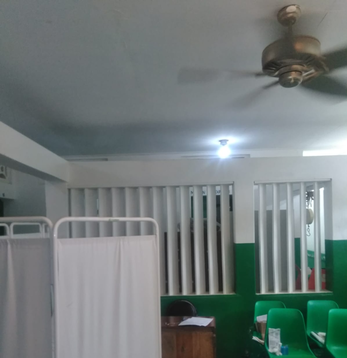
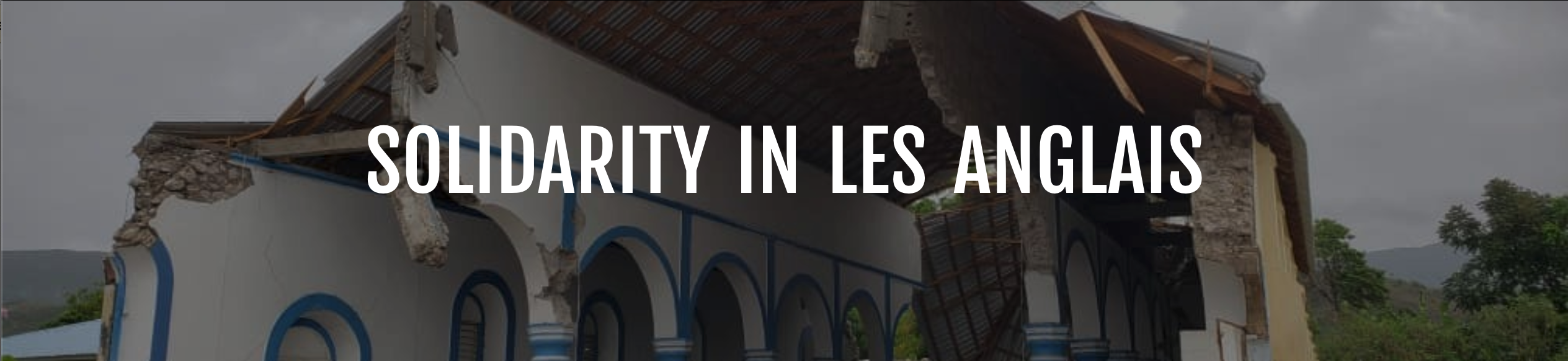
| EarthSpark has worked in Les Anglais for over a decade. The town was hit hard by the August 14 earthquake. The iconic church collapsed, crushing many who had been inside preparing for a baptism. Others were injured as the concrete walls and ceilings of homes and businesses fell. The region continues to feel aftershocks, and people are afraid more buildings will fall. Unable to feel safe indoors, many people have pulled bedding outside and are sleeping in the streets. The health clinic lacked basic supplies before the earthquake. The medical staff, now performing all work outdoors in the courtyard, have been struggling to meet the enormous need for care. With little privacy and inadequate medical supplies, childbirth is happening in the same area as the waiting room. There’s a lot of work to undo the structural injustices that have led to the current conditions, but while people are sleeping outside in the rain and infections are dangerously festering in broken limbs, we need all hands on deck helping victims. | 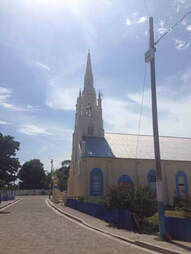 Before the Aug 14 earthquake, the now-toppled steeple was a gleaming icon of Les Anglais. The poles and wires visible in this photo are still standing and providing electricity to the town. |
Powering Through the Tragedy
When the earthquake hit, the EarthSpark team took quick action:
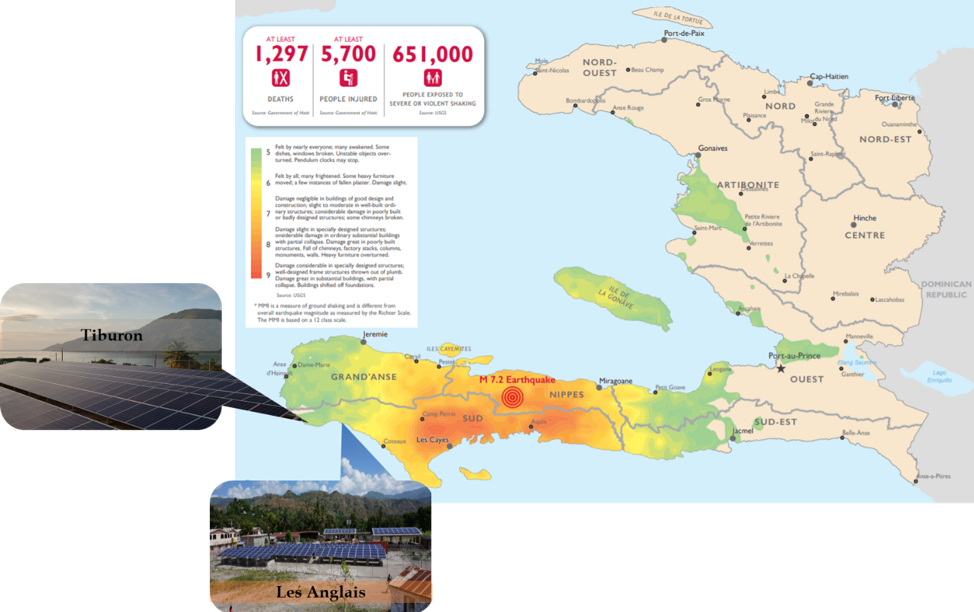
- Our 2 microgrids were able to power the towns through the tragedy, with total downtime <3 hours;
- We de-energized the Les Anglais grid immediately after the quake to check for damage;
- We had minimal structural damage to the grid and will not need specialized repairs;
- After ensuring energy provision, we have been helping ad hoc, turning the truck into an ambulance, a hearse; translating for emergency medical providers; coordinating air lift patients; advocating for relief services and supplies to reach the town of Les Anglais; installing new lights in the clinic; supporting our team and community as best we can.
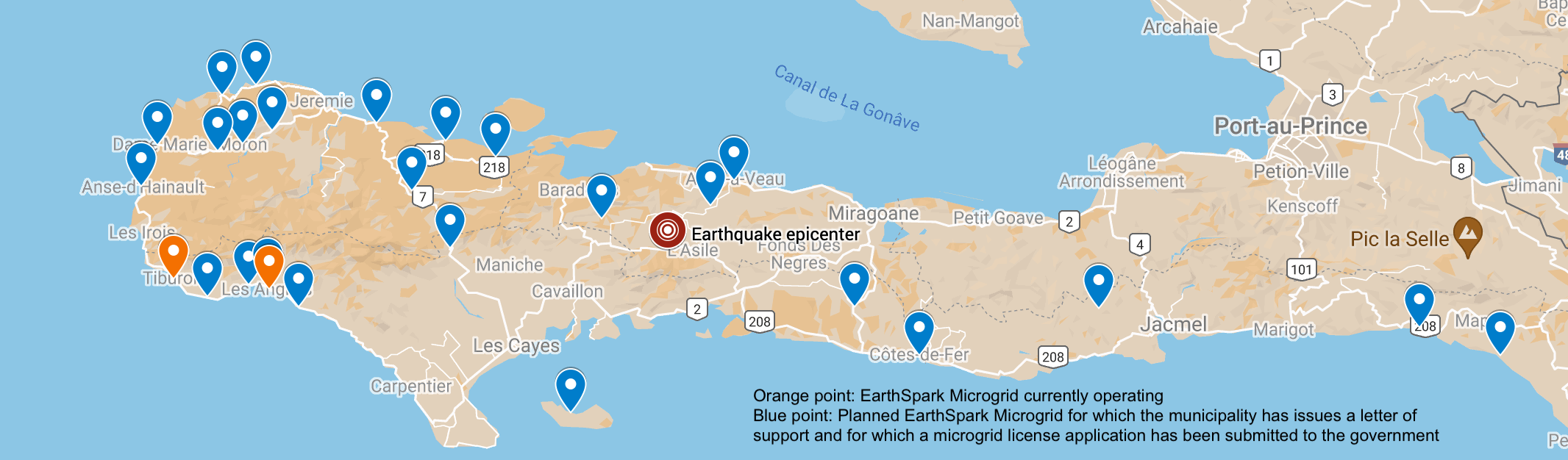
Being able to continue powering Les Anglais and Tiburon through the earthquake is a case example of the value of microgrids and distributed renewable energy. However, we were lucky this time that our grids withstood only minor damage. As we look to expand microgrids throughout the region, we will work with the municipalities, clinics, and government officials to make sure we do all we can to be ready for when the next disaster hits.
- We need on-site solar and batteries at locations providing critical services like at telecommunication towers and health clinics to ensure continuity of service even if the distribution grid is damaged (and to strengthen the grids during normal operations);
- Clinics need basic medical supplies onsite. We look to the health sector to lead on this, but as employers in these towns, it is also our responsibility to ensure our team has access to basic care.
- People need access to better construction materials and methods. Again, we hope others will lead on this, but microgrids cannot deliver electricity to structures that have collapsed or to homes that need to be torn down and rebuilt.
To support EarthSpark's ongoing work building affordable, reliable electricity service in rural Haiti, please
Thank you for your support!
This morning an earthquake hit southern Haiti, not far from EarthSpark’s operations.
It's been a whirlwind of a day. The damage is extensive in the region. The iconic church in Les Anglais collapsed while a baptism was taking place. Homes toppled. Bodies have been pulled from the rubble, and many remain missing.
Our EarthSpark and Enèji Pwòp teams are accounted for, but family members are injured. One of our colleagues lost his daughter. It's heartbreaking.
It's been a whirlwind of a day. The damage is extensive in the region. The iconic church in Les Anglais collapsed while a baptism was taking place. Homes toppled. Bodies have been pulled from the rubble, and many remain missing.
Our EarthSpark and Enèji Pwòp teams are accounted for, but family members are injured. One of our colleagues lost his daughter. It's heartbreaking.
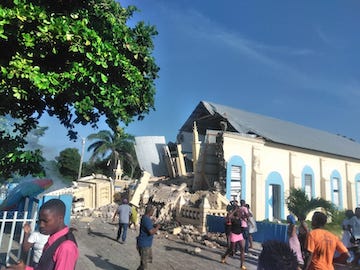
Les Anglais was hit harder than Tiburon. Both towns seem to have fared better than others in the region.
For safety, our team de-energized the Les Anglais grid for several hours to check for downed wires and await aftershocks. Both microgrids are back up and running now. I’m proud and relieved to say that EarthSpark’s systems seem to have fared well and are powering the towns through this tragedy.
With the grids sorted, Wendy and Jean are now busy trying to help our team and community members. Regional roads are impassible due to landslides. Hospitals on the other sides of the landslides are overwhelmed.
With all of the Haiti headlines focused on the awful events in Port-au-Prince recently, this is a tragic reminder that rural Haiti still urgently needs basic services and infrastructure.
For safety, our team de-energized the Les Anglais grid for several hours to check for downed wires and await aftershocks. Both microgrids are back up and running now. I’m proud and relieved to say that EarthSpark’s systems seem to have fared well and are powering the towns through this tragedy.
With the grids sorted, Wendy and Jean are now busy trying to help our team and community members. Regional roads are impassible due to landslides. Hospitals on the other sides of the landslides are overwhelmed.
With all of the Haiti headlines focused on the awful events in Port-au-Prince recently, this is a tragic reminder that rural Haiti still urgently needs basic services and infrastructure.
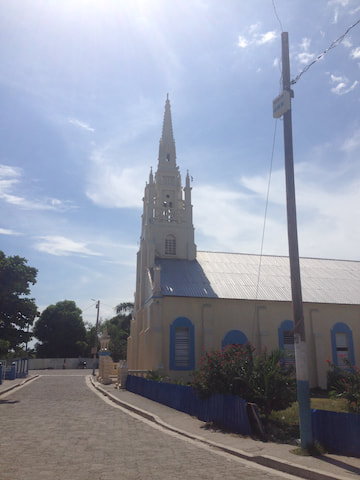
Before today's earthquake, the now-toppled steeple was a gleaming icon of Les Anglais. The poles and wires visible in this photo are still standing and providing electricity to the town.